
We fans have watched Rimuru grow from a simple slime. And those who watch fantasy anime know very well how weak a slime is. Like in every other Isekai anime starter town, there is a “Slime hunting ground” for the beginners. But how can our MC, Rimuru Tempest, be so weak, right?
Forget about being weak, he comes out of the starting area as a A rank named monster, and not just named by anyone. He was named by one of the strongest true dargons Veldora. After that, the speed of his growth was so alarmingly fast that I sometimes think how the author will manage the plot if MC get so damn strong so fast.
So, How Strong Is Rimuru Tempest at his peak? What heights does Rimuru reach at the end of the series? And a little spoiler for you, he gets one of the strongest across the animeverse. Yes, you understood it right, he just gets that much stronger.
How Strong Is Rimuru Tempest (Skills & Abilities)
1. Ciel Turns Rimuru Into a Walking Supercomputer That Cannot Be Outsmarted

We all remember when Raphael already felt unfair. It was calculating everything for Rimuru. Correcting him. Fixing his mistakes. But during the Eastern Empire war, Rimuru names Wisdom King Raphael, which creates Ciel, a Manas with its own ego and will. From there, Rimuru is now fighting with two minds running at the same time.
Actually, you saw the hint long before that. When Rimuru analysed Veldora’s Infinite Prison, a task that should have taken decades was solved in about a day after Great Sage evolved. In battles, Raphael was already predicting enemy attacks and activating counters automatically. After becoming Ciel, that speed and precision jump to another level. It stops being just assistance. It becomes an active battlefield control from inside Rimuru’s head.
That is why people say Rimuru cannot be outsmarted. The enemy thinks of one move. Ciel has already tested ten outcomes. Before a spell fully forms, Ciel has measured its power and chosen the perfect response. You are not fighting one brain. You are fighting a living calculation system that always moves first.
2. Void God Azathoth Lets Rimuru Devour Existence Itself

Azathoth, translated as “God of the Void” or “Lord of the Void,” appears in Light Novel Volume 16 after Ciel completes a massive synthesis. Ciel combines Beelzebuth, Raphael, and the Ultimate Skills connected to Veldora and Velgrynd into one authority. That fusion creates Void God Azathoth. It feels like a final evolution of all these skills.
The core idea behind Azathoth is void as absolute authority. When something falls under its effect, it is not treated like outside damage. It becomes internal material to use for Rimuru. The devouring ability no longer stops at matter or magicules. It can swallow the target whole and process it inside Rimuru’s inner world. Once absorbed, it stops being an enemy. It turns into usable energy and stored power.
That is why fans say Rimuru can devour existence itself. It is not just about defeating someone. The body, the attack, even the authority behind that being can be swallowed and converted. Durability stops mattering at that level. If Azathoth gains access, the opponent becomes fuel inside Rimuru’s system.
READ MORE: Who is Rimuru Tempest’s Wife?
3. Soul Gluttony Eats Souls, Skills, and Even Concepts
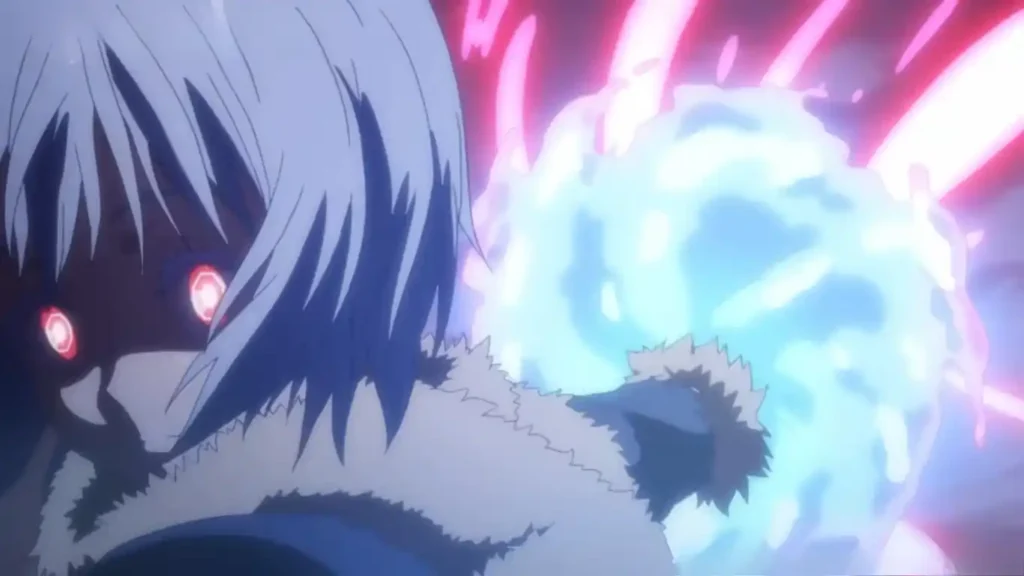
Soul Gluttony evolves from Rimuru’s Predation line(another skill). It happens in the Web Novel Chapter 191 when Ciel performs a synthesis. This skill is very simple and scary. It can absorb the target’s soul itself. From the beginning of the series, Predation already handled organic matter, inorganic matter, magic, and skills. After analysis, Rimuru could integrate what he consumed. Soul Gluttony does all that with steroids.
You can trace the foundation back to the Orc Disaster fight. Rimuru absorbs the Unique Skill “Starved” and merges it into Predator. Soul Gluttony is no longer about defeating flesh. It is about swallowing what defines the opponent. There is still one limit, though. If the enemy is fully conscious and resisting, the success rate drops until they are weakened.
The line about “even concepts” connects to how skills function as authorities in this world. When a skill is eaten and integrated, the rule behind it transfers.
4. Imaginary Space Is an Infinite Prison Where Enemies Become Energy
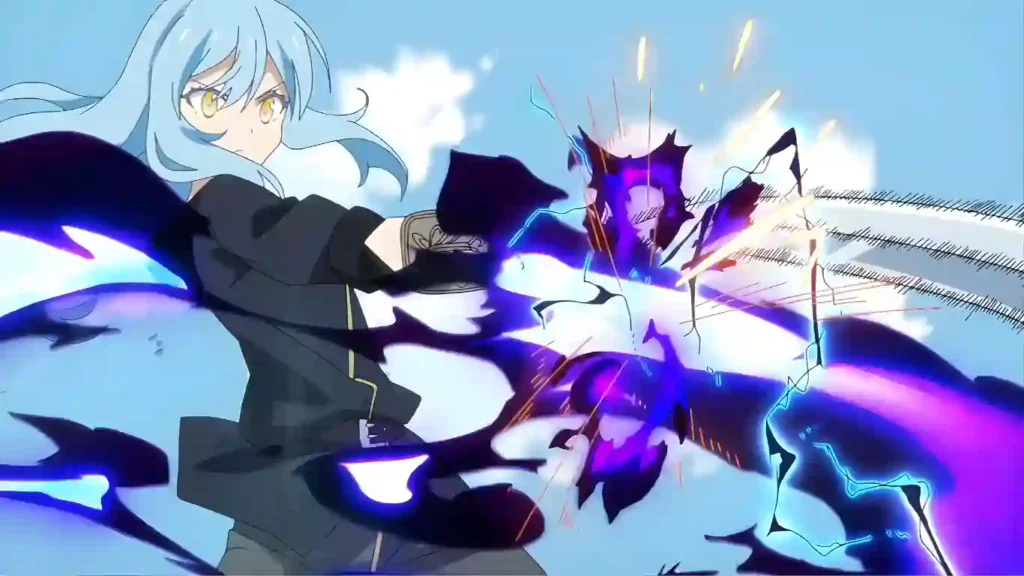
Imaginary Space is a hidden dimension tied to Rimuru’s devour-type powers. In the early stages, Predator’s “Stomach” stores targets in a place where time does not flow. This is just an evolved skill of that. On top of that, Isolation seals harmful effects and converts them into magicules.
Later, the story directly names it Imaginary Space. During high-risk battles, Rimuru even hides his main body inside it, while parallel existences fight outside. In the final confrontation with Yuuki, this dimension becomes a permanent prison. Once someone is trapped inside, it is impossible to escape. Even if Rimuru were to die, nothing would change.
Ciel also confirms that Imaginary Space is infinite and never fills up. That removes any overflow limit. Anything locked inside stops being an outside threat. Whether it is Veldora resting safely or a defeated enemy sealed forever, this dimension works as both an energy generator and an absolute prison. Once you are inside, you are no longer part of the outside world.
5. Nihility Collapse Erases Information, Not Just Bodies
Nihility Collapse is described as a collapse-factor energy. This is not normal elemental damage like burn, freeze, or crush. It attacks the information layer that defines the structure itself. In the Web Novel, Rimuru tries to test it by powering a tiny flame spell. He keeps the output low on purpose, which leads to a violent explosion. Nihility Collapse cannot be casually toned down.
Later, you see its defensive use. Rimuru deploys a Nihility-based barrier. Anything that touches it gets erased and converted into void energy. It is about rewriting what the object is at its core. Once contact happens, the target stops existing in its original form. (😥It feels like I am hyping up, but this is the definition I could get for this.)
This is so strong that Rimuru’s own vessel cannot endure Nihility Collapse for long. Using it recklessly guarantees victory, but might be dangerous. The narrative treats it as a power that is hostile to stable existence itself. Once activated, it does not see on a durability scale.
READ MORE: When Does Rimuru Become A Human?
6. Spacetime Domination Gives Rimuru Control Over Space and Time

Spacetime Domination is high-tier authority over space and temporal flow. It controls position and time at the rule level. In the Web Novel disappearance sequence, Rimuru fixes the spatial coordinates of a barrier around Lucia and adds time attributes that remain stable for hundreds of years. That scene is about locking reality into place.
Later, during the Yuuki confrontation, time stop is used against Rimuru. That should have ended the fight. But Ciel explains that Instant Move is not limited to previously visited points. It is an early form of higher spacetime traversal. Rimuru’s authority crosses spacetime itself.
That made time stop unreliable as a prison for Rimuru. That turned into a fight between, who have better control over the rules of time and space. When Rimuru uses Instant Move mid-fight to appear behind an enemy, the movement leaves visible spatial distortion.
7. Multidimensional Barrier Makes Physical and Magical Attacks Meaningless
Multidimensional Barrier is described as an always-active multilayer defence. It uses dimensional separation, often referred to as Dimension Fault, to prevent attacks from reaching Rimuru’s true position. Instead of blocking impact, it cuts the connection between attacker and target at the dimensional level.
The barrier operates constantly. Even casual proximity does not threaten Rimuru because the protection remains active unconsciously. The series frames it as an Ultimate Skill class defence. That places it in the same tier as high-authority offensive abilities. Breaking one layer does not expose Rimuru directly because the separation is still there.
Physical strikes, magic blasts, and direct contact will fail all of the time. Unless the attacker can bypass dimensional separation itself. If the attack cannot reach Rimuru, what will even enemy do? Damage calculation becomes irrelevant in this case. (Don’t you think this is similar to Gojo’s infinity in a sense?)
8. Imaginary Blade Cuts Once and Converts the Target Into Fuel
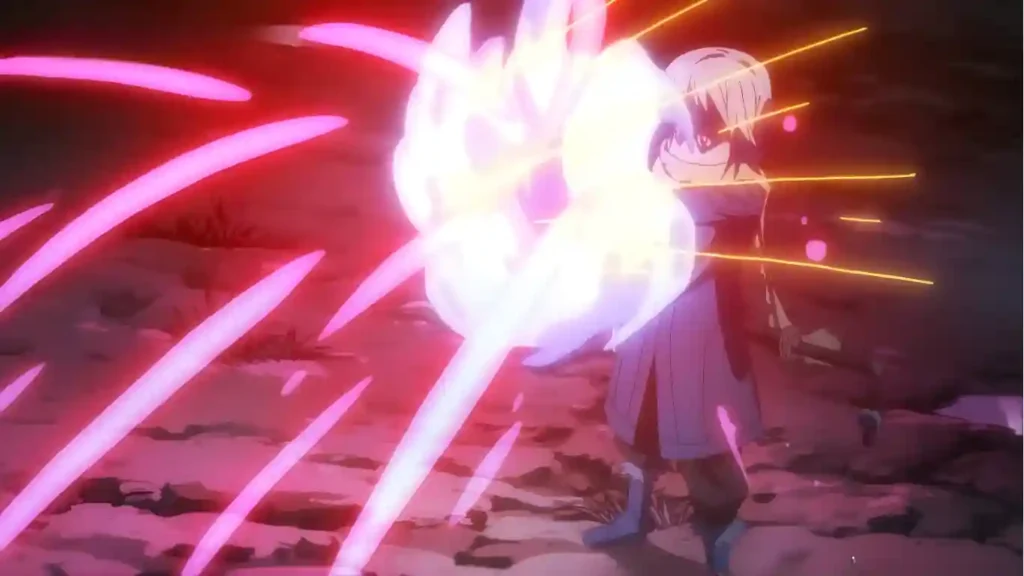
Imaginary Blade appears in Light Novel Volume 19. Rimuru coats his sword with Nihility Collapse energy and swings once, just one slash. And this was a killing strike, on the same level as the strongest sword arts in the series.
Whatever the blade touches is forcibly transferred into Imaginary Space under Azathoth’s authority. The strike does not leave a corpse or ruins behind. The target is pulled inside and processed instantly. It feels unfair at this point.
During the royal capital conflict involving Feldway and Leon, Rimuru reveals the Imaginary Blade early to end things fast. The fact that Feldway manages to stop it becomes a serious moment.
9. True Dragon Release Lets Rimuru Deploy Veldora and Velgrynd Like Living Weapons
True Dragon Release [Scorch・Storm] works as a special form of Parallel Existence. When Rimuru activates it, Veldora or Velgrynd manifest an “other body” in the outside world. While their core remains assimilated inside Rimuru. The dragon’s energy is loaned into that manifested body.
When the release ends, the energy flows back to Rimuru. This is the controlled deployment of a full True Dragon existence.
Their memories and cores remain stored within Rimuru’s soul and mind. As long as Rimuru exists, the dragons remain recoverable. That is why this reads like deploying living weapons instead of risking permanent loss.
10. True Dragon Nucleation Turns Dragon Energy Into a Divine Core Weapon
True Dragon Nucleation is described as converting a True Dragon into a “Blade Core” that fits directly into Rimuru’s sword. Consent is still required, though. Once nucleated, the dragon’s existence compresses into a concentrated core of power.

Rimuru states clearly that the full output is too powerful for normal use. Instead of using it at one hundred per cent, he creates degraded pseudo cores at around five per cent output for practical combat. Five percent is already more than enough for serious fights; The complete version would be too hard for even Rimuru to handle.
The sword Elpis is designed to handle this system with multiple core slots. When Veldora’s nucleated core is inserted, Rimuru wields True Dragon power directly through his blade. It is a compressed dragon-class energy operating as a divine engine.
11. Shub-Niggurath Lets Rimuru Manufacture Ultimate Skills
Shub-Niggurath is a management engine for Rimuru’s entire ability system. Inside it exist four core authorities: Ability Creation, Ability Duplication, Ability Gifting, and Ability Preservation. Together, they turn skills into stored and editable information. That means powers become data, which Rimuru can shape, copy, and assign when needed.
You see the proof right after its formation. Rimuru’s executives evolve at the same time. Each receives a tailored Ultimate Skill based on aptitude. Benimaru gains Amaterasu. Souei gains Tsukuyomi. These are custom-built upgrades assembled through Shub-Niggurath’s internal framework.
Skill Creation
Skill Creation sits inside Shub-Niggurath. It creates new abilities from gathered data. The raw material is not a single stolen skill. It is a library of combat records, resistances, and soul-linked growth patterns accumulated through Food Chain and Analysis.
Ability Creation works using information gathered through the Food Chain and Analysis to build new powers. Ability Duplication copies skills Rimuru already owns. Ability Gifting transfers those copies to the right person. Ability Preservation keeps abilities stored as reproducible information instead of crowding Rimuru’s personal set. It is organised skill engineering at a system level.
Skill Duplication
Skill Duplication allows Rimuru to reproduce abilities he has already acquired. Once an enemy skill is analysed and integrated, it becomes data that can be copied. This shifts enemy powers from temporary threats into permanent assets within Rimuru’s system.
The Orc Disaster case sets the template. Rimuru absorbs the ability behind “Starved,” and Predator evolves into Gluttony. These are not peak Rimuru’s powers; he gets these early on. But they are just too op.
12. Food Chain Turns His Entire Nation Into a Power Multiplier

Rimuru got the Food Chain skill when he turned into a Demon Lord. Food Chain connects Rimuru to all monsters under his influence. When subordinates gain abilities, those gains are fed back to him. We could see all of his subordinates getting a power-up by this skill in the anime.
During the Eastern Empire conflict, this mechanic operates in real time. As his forces evolve and grow stronger, the returns flow back through the soul lineage network. His growth does not depend solely on personal effort, but also on the efforts of his subordinates.
13. Nihility Supply Lets Rimuru Share God-Level Energy With His Strongest Subordinates
Nihility Supply appears in Light Novel Volume 20 as an Art created by Ciel. It allows select subordinates to temporarily access Nihility Collapse energy through Soul Corridors. The recipients named are Benimaru, Diablo, Testarossa, Ultima, and Carrera.
Nihility Collapse is described as energy capable of destroying information itself. Even Rimuru treats it cautiously. Only the highest-tier subordinates are permitted to wield it, and only for short periods. The risk to their lives is explicitly acknowledged.
In large-scale clashes like Milim and Velzard, Nihility Supply worked very well.
14. Post-True Dragon Evolution Removes His Mortal Limits Completely
Rimuru’s evolution after the Empire conflict marks a shift into True Dragon-class existence. The official synopsis notes further evolution after he clashes with Velgrynd. Reference material describes him as an Ultimate Slime with a True Dragon-equivalent nature.
True Dragons are spiritual life-forms. Their bodies are not fixed biological anchors. They can assume forms freely and construct material bodies from magicules.
Who Can Still Challenge Peak Rimuru

At his peak, the word “challenge” changes meaning. Demon Lords and armies are no longer the benchmark for him anymore. The story frames only crisis-level beings as real threats. Michael is positioned as Rimuru’s archenemy. Even after Rimuru defeats him, the narrative does not treat that moment as the final stop. The war continues on several fronts, which shows that beating Michael does not erase the larger danger.
Velzard can also challenge Rimuru. As the eldest of the remaining True Dragons, her arrival shifts the entire battlefield. She freezes the war zone and changes the balance instantly. Milim Nava can also be problematic. When she began rampaging during Velzard’s intervention, Rimuru was forced to return personally.
Feldway functions as the long-game antagonist. His schemes lead to Leon being taken and push major fighters into action. The conflict keeps expanding because of his moves. Then the story introduces a world-level catastrophe in Ivalage, labelled as a World-Destroyer Dragon. Don’t worry, Rimuru can still be challenged by a lot of entities. We don’t want an MC with out a enemy, right?
Final thoughts.
Peak Rimuru is no longer measured against Demon Lords or single rivals. His scale moves into True Dragon authority, world-level disasters, and soul-level survival rules. At this point, fights stop being about who punches harder.
While writing this blog, “How Strong Is Rimuru Tempest”, sometime its felt like I am taking a physics class. Bro is just too strong at the end of the light novel. And he is still growing. I hope the author can manage this type of extreme power scale.
And if there is an error or you don’t agree with somethign you can comment below. Or you can share your thoughts as well.